Tuesday, August 31, 2010

Nursery Harvest

I was at my neighborhood nursery yesterday and noticed how ripe their prickly pears looked. Feeling brave, I asked if I might be able to harvest some. Without hesitation I was given free reign to harvest as many as I'd like. I was also told to have at it with a peach tree that had lost some limbs due to heavy fruiting.


So this morning I headed over with my gloves and tongs and began the harvest. The fruit on these plants was significantly larger than those from my neighbor. I mean, look at them!


It didn't take long before I'd filled up the containers I'd brought with me and I'd barely made a dent in the number of remaining fruit.


After spending much of the day processing, the juice from the two rectangular containers  made 12 half pints of low-sugar jelly and filled 3 ice cube trays with unsweetened juice. I still have the two yogurt containers left but those will have to wait until tomorrow. It's too hot in the kitchen!

I started harvesting peaches, too and this is what I brought home today as it was all that would fit in the pannier with the prickly pears. I can't wait to go back tomorrow and pick some more. I sense some spiced peach jam on the horizon...


Sad News

Well, Red died today. She's been struggling with something for a while and now she is free of whatever it was that ailed her.


She was our favorite because she didn't mind being held and all the kids that met her loved her easy-going ways. She'll be missed...

Monday, August 30, 2010

Aspen Vista Ride


Yesterday we drove up to Santa Fe where the temperatures are cooler and the views incredible. We wanted to test out our 80s vintage mountain/touring bikes. There's Lane with his all-chrome Ross. Aspen Vista is off the winding and climbing road to the Santa Fe Ski Area. We've done this ride before-actually we seem to do it annually and right about this time of year. It is a steady climb on a forest road and is enjoyed by hikers, cyclists and dogs.

Although heavily traveled toward the bottom, we had the road to ourselves as we inched toward the top. We saw mountain jays, ravens, chipmunks and squirrels and lots of fungi. Here were just a few examples:


The route we usually take makes a loop--from the trailhead, to the ski area, down the ski slopes and along the road back to the car. On this day we almost made it to the ski area. We were both exhausted and I was worried about what looked like an incoming monsoon.


The ride down was swift and over too fast. The storm never materialized and we enjoyed an early dinner in town before hitting the road back. As I rode to the co-op today I was reminded about just how hard my legs were worked. Satisfying.

Sunday, August 29, 2010

A Tour of the Future Oasis

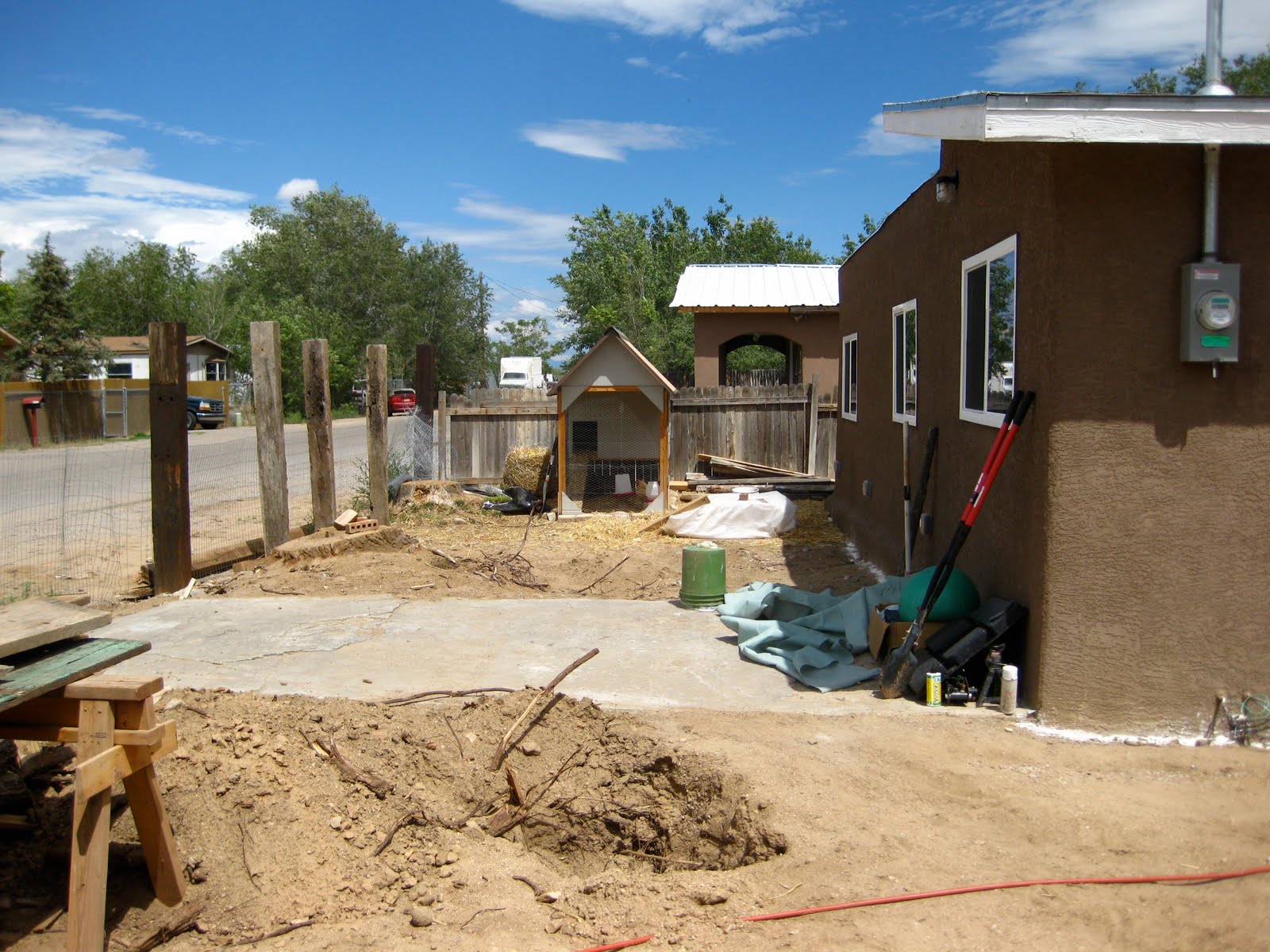
Since we have such big designs for our yard, I thought I'd let you see what we're working with. It's actually like a blank canvas--there are exactly zero other plantings we have to consider and the yard has been more or less graded for good drainage. The one element to consider is the trunks left behind by the huge Siberian elms. They really want to live, but we're slowly removing the bark and continuing to cut back the suckers. The trees (weeds?) that just won't die.

This "tour" will go from East to West. I didn't bother taking any pictures of the northern side of the yard because it's less than 5 feet from our house to the fence. Not much to work with there. Here, however is the eastern side of the yard. We're doing some rainwater harvesting-note the barrels--but we currently have no where to put the water. I guess it's recharging the aquifer and keeping the water off the stucco. It started to discolor the stucco before we installed the gutters/barrels. Someone at the nursery told me that the composition of rainwater changes here due to the electrical activity during lightning storms. Pretty wild.  Speaking of rainstorms, the tarp on the roof is for a small leak we discovered during a real gully washer. It's a quick fix, but we haven't gotten around to it yet. The white trail around the perimeter of the yard and house is food-grade diatomaceous earth. We are trying to keep the neighbor's ant infestation from infiltrating our space. 

What are our plans here? I'm not entirely sure but maybe a small tree and some currant bushes; a gate/fence to keep the chickens out of the garden; a path of some kind. This is not our first priority. I'm really getting a feel for patience with this project. As much as I want an instant yard, I know that's not realistic on many levels. This is a process.


Moving along we come to the front yard, the eastern side.  This is really not a picture representative of the space we have to work with. It is also still torn up from the irrigation project. Update: the neighbors now have water lines on their side of the property! The distribution box should be finished in the next week or two. The big green umbrella was to shade those (un)fortunate enough to have to work on this project (i.e. Lane).

This is where the water from the acequia will run onto the property. My hope is to have 3 vegetable beds here, about 4 feet wide and 10-12 feet long. I also want to experiment with sunken, ground-level and raised beds. I think they all have their place in this climate during different seasons. That will be a work in progress, too. I don't think we can get anything planted for a fall/winter crop. The first frost date is in October, which is fast approaching. I think we're going to concentrate on our infrastructure and getting the fruit trees established and then plant for spring.


Here we come to the western side of the front yard. The south side is a "fence" of firewood. The strange white thing in the right corner is our wood stove. It needs to have 2 of its lets welded back on as they were casualties of the move. We love this stove. It's designed to heat 1200 sq. ft. so we should have no problem keeping our 900 sq. ft. studio toasty warm.

The mounds of earth are sitting next to the holes for the future semi-dwarf/dwarf fruit trees: apricot, plum, apple, peach; we haven't decided yet. All of the trees and most of the plants will come from Plants of the Southwest. They are right up the street and everything is geared toward our climate. Along the picket fence in progress we're going to put up a covered patio/porch. It will be really rustic and somewhere to have a cup of coffee or fire up the grill. If you are in just the right spot you can also see Sandia. Of course you have to look past the telephone wires and the industrial building, but it's there!


At our final stop on the tour is the western side yard. It came with a "driveway" which has been useful for car projects and keeping one vehicle off the street.  That may become a covered carport. Where that bucket is we'd like to put up a fence/gate to keep the chickens in the back. They'll get full range of the yard sometimes, and under supervision, once the garden is planted. Their voracious appetite could destroy our crops in a blink of an eye.

We'd like to put up a shed along the property line. It would be rustic as well, using more reclaimed barn wood from our generous neighbor. I had originally thought of strawbale, but the thickness of the walls would really cut into our available space on this dinky lot. Our thought is to get it started this fall and get the tools out of the house. I'd also like to put a cold frame along the southern side of the house and the shed for winter crops. That's a ways off, too.


We have a lot of work ahead, but it's enjoyable to see the space evolve and change. As things progress I'll keep posting pictures so you can witness the transformation, too.

Friday, August 27, 2010

Prickly Pear Goodness


This is the time of the year for harvesting prickly pears known in Spanish as tuna. They grow on the prickly pear cactus and have many uses: jam, juice, vinegar, wine, syrup and the cochineal insect that eats the fruit has been used to make dye. The pads of the cactus are also edible and are called nopales. The cactus is quite prolific in Albuquerque and comes in many varieties. Some have large fruit, about 4 inches long and others, like the ones above, are just a couple of inches long.

Our neighbor has quite a large, sprawling plant and he wasn't planning on harvesting the fruit this year so he let me have at it. I harvested enough to make 10 cups of juice! The process for harvesting and processing prickly pears is time consuming but, in my opinion, worth it. I've found myself scouting out other plants in the area to inquire about harvesting. We'd have juice and jam to last through the year!

The first step in prickly pear harvesting is to pluck the fruit from the spiny cactus. Even though the spines on the cactus pads look vicious, the small ones on the fruit are even more sinister. Called glochids, these miniscule spines can be very painful and hard to remove. So, harvesting the pears involves using long tongs and I would recommend wearing leather gloves, too. 


Once harvested, it's time to process them. The first step is to remove those nasty glochids. Some websites recommend wearing gloves and scrubbing them with a vegetable brush. I felt like that was a little too close to the glochids, so I went for the burn-'em-off strategy. Holding the fruit in metal tongs I ran each one through the flame of my gas stove. This is what took the longest, since the fruit were so small. You can see some of the glochid casualties on the stovetop.

Nasty little buggers

Once the glochids have been removed, I put the whole fruit in a large, non-reactive pot, filled it with water to cover, and brought it to a rolling boil.  (If the fruit were bigger, I would have halved or quartered them. ) It boiled for a good 10 minutes and then I removed it from the heat. With a potato masher I crushed the fruit until it seemed like there weren't any whole fruit remaining. Next I strained the juice by placing a fine mesh strainer over a large bowl. Into the strainer I put two layers of cheesecloth and ladled the mess into it. When it seemed like it was just about finished straining, I gathered up the corners of the cheesecloth (I recommend putting your gloves back on.) and gave the bundle a few good squeezes with a clean pair of tongs to get out the last remaining juice. Prickly pear juice is thick and kind of gooey. It reminded me a bit of okra slime, but the color is all together different.
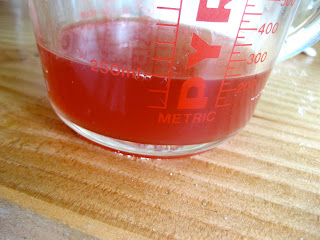


From this point you can do just about anything with the juice. I used 4 cups and this recipe from Homegrown Evolution to make 6 half-pints of jelly. I chose not to hot-water process them and just put them in the fridge. Some of the jars didn't set up quite right, but we had delicious pancakes with prickly pear "syrup" for breakfast the next morning!

For the rest of the juice I added some sugar and poured it into ice cube trays so we can have juicy drinks anytime. I'm not sure if it's the gooey nature of the juice or the added sugar that made the cubes sticky and a touch tricky to remove from the trays. I'm working on some recipes using the juice. It definitely needs to be diluted, sweetened and mixed with something. So far lemon and lime juices have worked out well. I think a carbonated lemonade would be divine. I'm also toying with the idea of adding it to home-brewed kombucha. (I just started my first batch today! Watch for future posts on that.)


After the processing I was really careful with the clean up. I could see glochids everywhere and wanted to limit our interaction with these small brutes of nature. Even though I wore gloves, used disposable rags and cleaned quite thoroughly I ended up with more glochids piercing my hands days after the project. This won't deter me, however. I will certainly do it all again and, hopefully, in the near future.

Wednesday, August 25, 2010

Gusts to 50? Let's Go for a Ride!

We just look like we're full of energy.

Yesterday neither one of us had anything pressing and the high was supposed to be in the 70s--a perfect day for a ride and a hike, right? We thought so. We packed up the bikes with our hiking boots, water and snacks and set out for Sandia and the La Luz Trail. The trailhead is only 14 miles and a steady incline from our house, which we thought would be no big deal. We loaded our daypacks, strapped them to our racks and headed off. 

As we were finishing up a light lunch at Annapurna's, the wind kicked in. It seemed like it was coming from the East--from the mountain--and boy was it ever. Once we hit the road the wind blew steadily at 25-35 mph and had gusts up to 50. This proved to be very brutal. We could barely go 4 miles per hour into the headwind. After 9 miles we were second-guessing this plan and at 12, just 2 more miles uphill, we decided to call it a day. After slogging for 2 1/2 hours uphill, with the wind at our backs and gravity taking us downhill, we were home in less than an hour. Our maximum speed was 34 mph. We could have gone faster, but there is something unsettling about going really fast with a gusting crosswind. Wimps, I know.


At least we had this beautiful scenery. We also came upon an historical marker. It didn't designate a place, however, but recognized a person. "Lola" Chavez de Armijo was state librarian in 1909. The governor tried to oust her because she was a woman. She fought and won a landmark discrimination case and is now considered one of New Mexico's Notable Hispanics. Other interesting landmarks were a decomposing coyote or fox and a group of ravens lingering near an unidentifiable smell. It was a beautiful, challenging ride and one we'd like to repeat--minus the wind.

Monday, August 23, 2010

Irrigation Project at a Stand Still

Uh oh
This weekend sure was busy. Usually things are pretty quiet around here--little house projects, breakfast at Sophia's, tooling around on bikes. The last three days have been exceptions.

After spending the day harvesting and processing prickly pears, Friday night we drove up to Cochiti area to a friend's so we could be there for her 6am hay delivery. She has two rambunctious kittens who did not allow us to get more than a few winks of sleep. Six o'clock came early. We unloaded and stacked over 200 bales of hay, had a quick bite and coffee and headed back to Albuquerque. Once home we started digging for the big irrigation project. Running water from the acequia was going to be a multi-step affair. Part of it included us digging by hand, very carefully, around the gas and water utilities. It took a fair amount of time. Our neighbor and his friend got to work excavating from the ditch to our property. Here he is working his tractor.

They worked all day digging and laying the pipe that was purchased Friday. At the end of the day they were short on pipe and short on daylight. As night fell we had an open trench with 40 feet of pipe nestled inside. Covering it up and finishing the job would have to wait until Sunday.


The completed trench was re-graded, the pipe dropped in and covered without a hitch. Then they started digging for the distribution box. This collects the water as it's distributed around the property. At first a lot of old cinder blocks were being unearthed. Then we heard "shut it off!!" Well, they hit water but, strangely,  it wasn't ours. Things are a bit funky here in the North Valley. All of our walls are curvy and the house next door as quirks of its own. This one takes the cake. Their water main runs from their property, over to ours and then zig zags back to their property. The only rational reason for this is the giant Siberian elm that may have impeded running the main straight back. It's odd and now it needs to be rectified. Here's a reminder as to what it looks like:

The copper flex line was installed so they will continue to have water until we all figure out what to do. In the meantime, 5 holes were dug for future fruit trees and some concrete was removed to be taken to the recycler. We also went back to our friend's in Cochiti to have a potluck. I made delicious peach-blackberry crisp and she served deviled eggs and corn from her flock and garden. Absolutely delightful. The drive back was partially illuminated by the moon and looking out on the hills and sage reminded me, yet again, why I like it here so much.

Stay tuned to find out how this irrigation dilemma is resolved...